
by Jayakrishnan, Digital Marketer
Brands post content and hope for likes. I stopped doing that after I discovered a pattern. Some types of posts spark conversations more than others. Those posts bring traffic to the brand.
That pattern is the foundation of Social-First Ranking Strategies. If you focus on likes, you create content that invites comments, shares, and saves. Those engagement signals place your posts higher on a platform, giving them visibility.
In this post, you will learn how a platform ranks the Social-First Ranking Strategies five‑step framework, the mistakes, and one change you can try this week to improve your results.
What Are Social-First Ranking Strategies?
Social-First Ranking Strategies mean creating content that focuses on sharing. It is about visibility in feeds, Reels, Explore pages, and in‑app search, not just using SEO to rank your website on Google. It is similar to social media SEO and other media ranking strategies. With a small difference. Social media SEO begins with keywords. Social-First Ranking Strategies begin with the signals that each platform values and then add keywords, engagement hooks, and captions around those signals.
Keep in mind that Social-First Ranking Strategies usually work on each platform itself. Likes and shares do not directly change your search engine visibility. Any rise in search visibility is a bonus.
How Social Platforms Decide What to Show
Instagram’s head, Adam Mosseri, says that every part of the app has its ranking signals. Some signals are similar. Some parts reward engagement while others reward watch time or closeness. You can read about the ranking signals on the Meta Transparency Center.
Mosseri has also said that watch time and likes per reach are indicators of content quality. Take this with a grain of salt because each platform changes its algorithm. What works for one account may not work for another.
Show what it rewards.
– Feed Engagement: Ask questions, reply to comments
– Reels: Watch time and entertainment value with a hook
– Stories: Closeness and replies
– Use polls and question stickers
– Explore: Interest match and engagement
– Stick to one topic per post
Social-First Ranking Strategies 5-Step Framework
This is how Social-First Ranking Strategies guide you when creating content. The main idea is simple: people platform next. Let’s go through it step by step.
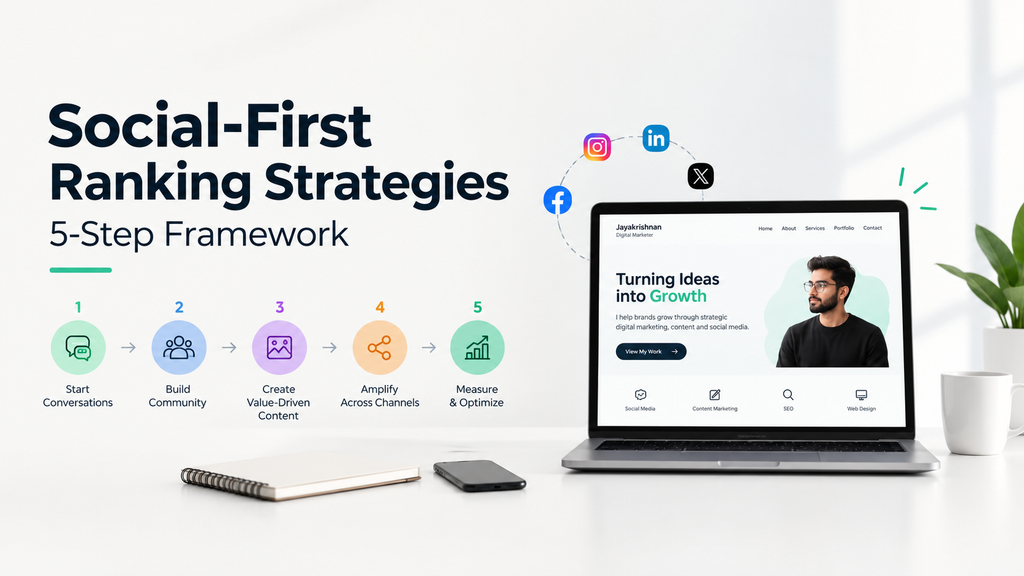
1. Know your audience
List the interests, questions, and problems of your audience. Compare those with the posts that worked best for you.
2. Research
Look for topics that your competitors focus on. Check your content and find patterns. Pay attention to trends, not examples.
3. Choose your point of view
Make a mix of content, but start with value. Promote products after you provide value.
4. Make it engaging
Use a hook, pictures, and a call‑to‑action question. When asking people to like your post, ask what their biggest challenge with X is. More and more platforms act like search engines, so use the words that your audience actually searches for in your post title, caption, on‑screen text, and alt text where it makes sense. Keep it natural; avoid putting keywords in a row.
5. Improve
Check reach, watch time, shares, saves, comments, and conversions. Use that data to adjust your posts.
What This Looks Like in Life
I think it is important to give an example. In one of our posts, we asked our audience to share their thoughts on a feature we’re considering adding. The post got engagement from people who answered the question and shared their real problems.
When I changed my focus from selling things to asking questions, giving advice, and solving problems, I noticed three changes:
1. Comments became more thoughtful. They had personal stories and questions.
2. Conversations often continued in messages.
3. It became much easier to find my audience—people who simply click the like button.
I have not measured results because I lack before-and-after numbers. I am writing this from what I observed. A case study on LinkedIn by BeKonstructive Marketing reported a 59.9 percent rise in impressions, a 183.5 percent rise in engagement, and 136.6 percent more comments over four months. Those figures come from BeKonstructive Marketing, not from me. Each industry and account is unique, so results may vary.
Common Mistakes to Avoid
Numbers such as likes and views may look impressive. They do not reveal the quality of your media ranking strategies.
Promotional posts. If you share content, you will receive little interaction.
No reply. If someone comments, you should reply to keep the conversation going.
Try This One Change This Week
1. Choose one post to test.
2. Rewrite it from the point of view of your customer’s problems.
3. End with a question that they can answer in one sentence.
4. Reply to comments if you can.
5. After a week, look at the comments, shares, and reach and compare them with posts.
FAQs on Social-First Ranking Strategies
What is the difference between social media SEO and ranking strategies?
Social media SEO begins with keywords. Ranking strategies begin with engagement, watch time, and shares before adding keywords.
Do shares matter more than likes?
It depends. In some cases, shares and saves show more interest than likes, which often require less effort. Each platform is different, so try a bit and find what works for your audience.
How long until I see results?
Follow the seven‑day test I mentioned and collect data from posts. One post is a sample, not a trend.
Ranking strategies really come down to one thing: giving people a reason to talk. Know your audience, solve their problems, join the conversation, and let the data tell you what to do. Start with one post this week. Build from there.
Conclusion on Social-First Ranking Strategies
Social-First Ranking Strategies help brands improve social media visibility by creating content that encourages meaningful conversations, shares, saves, and comments. Instead of focusing only on likes or promotional posts, businesses should understand their audience, provide valuable information, and use engaging questions to build stronger connections. By combining social media SEO, relevant keywords, and platform-specific engagement signals, marketers can improve content discoverability and reach the right audience. Follow the five-step framework—know your audience, research topics, choose your point of view, create engaging content, and measure results—to refine your content strategy over time. Start with one post this week, encourage genuine conversations, and use your analytics to discover what works best. With consistent testing and improvement, Social-First Ranking Strategies can become an effective part of your digital marketing strategy.
need more? connect me here.